Project case study
Event-Driven Workflow Scheduler
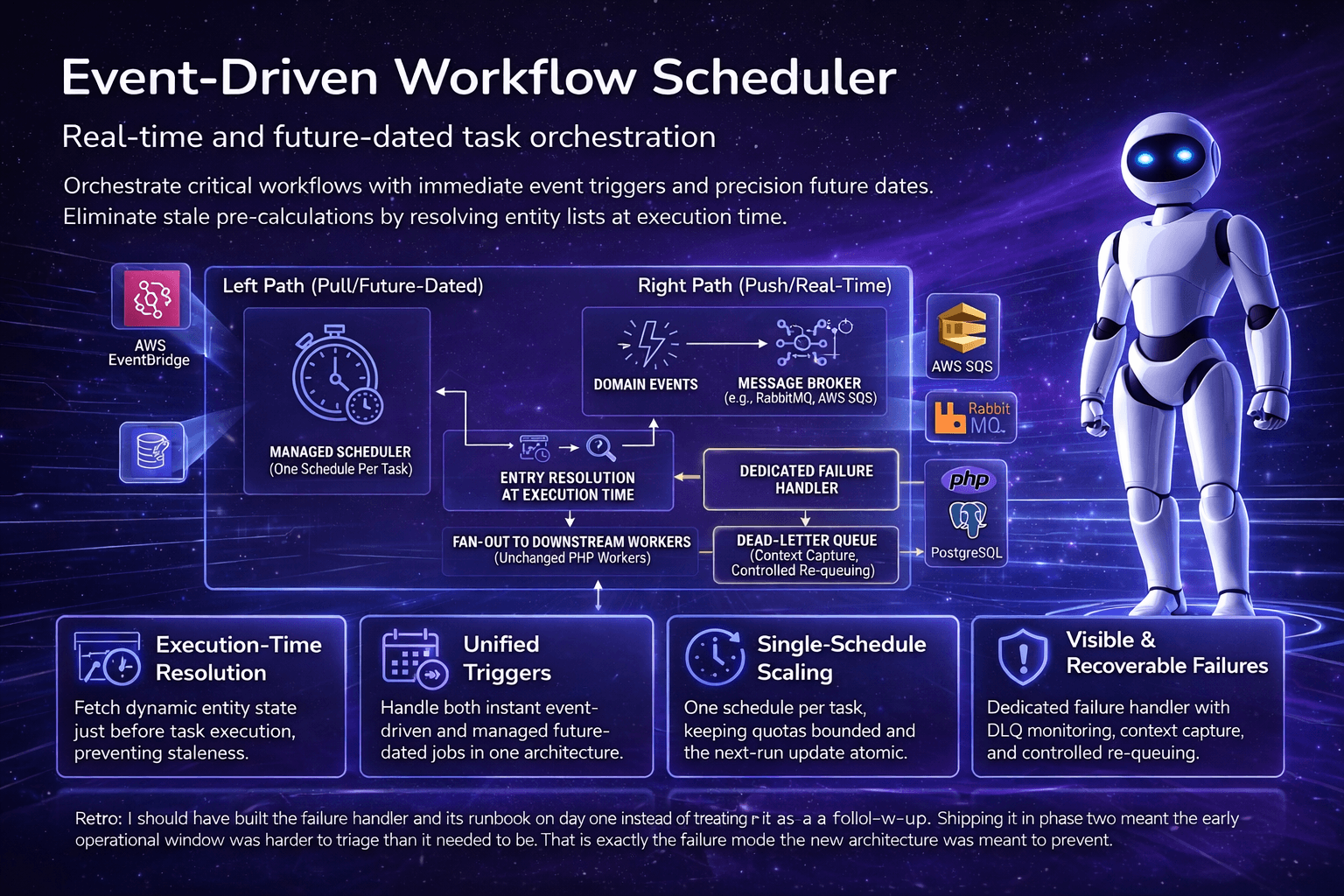
Dual-path event scheduler for real-time and future-dated triggers. Push path for immediate domain events, pull path via a managed scheduler for precise timestamps, with a dedicated failure handler for safe recovery.
Private implementation; details are shared at an architectural level.
Problem
- Existing scheduler only supported fixed intervals and a single daily polling pass
- No way to trigger work on a real-time domain event
- No precision on future-dated triggers
- Critical time windows needed manual babysitting
- Data pre-calculated before execution went stale by the time it ran
Constraints
- Scheduling drives real user-facing operations, a missed run is a real miss
- Has to support real-time and future-dated triggers in one coherent design
- State changes between scheduling and firing, so pre-resolving entity lists is not safe
- Failures must be visible and recoverable, not silent
- Has to coexist with the existing downstream workers, not replace them
What We Tried First
- First instinct was to pre-resolve the full entity list inside the daily pre-calculation pass
- Simpler pipeline, easier to test, fewer moving parts
- Did not survive first contact with real state changes between pre-calc and execution
- The scheduler was firing on a stale snapshot of the world
- That was the point where entity resolution had to move to execution time and the dual-path design stopped being optional
Architecture
- Two deliberate paths, separated on purpose: push for real-time triggers, pull for future-dated
- Push path wires domain events straight to the existing message broker
- Pull path uses a managed scheduler with one schedule per task, not one per entity
- Entities are resolved at execution time, then fanned out to the existing downstream workers unchanged
- A dedicated failure handler watches the dead-letter queue, captures context, and allows controlled re-queuing
Tradeoffs
- Execution-time entity resolution over pre-calculation. Simpler to pre-calc but stale data is worse than no data
- One schedule per task over one per entity. Keeps quota pressure bounded and the next-run update atomic
- Reuse the existing message broker instead of rewriting downstream workers. Coexistence beats big-bang migration
- Minimal payloads at the scheduling boundary, entity fan-out after. Keeps scheduling cheap and entity logic centralised
- Dedicated failure handler over best-effort logging. Silent failures in a scheduling system are the worst kind
Outcome
- Scheduling moved from once-daily polling to exact-time delivery
- Failures are now visible and recoverable instead of silent
- Downstream workers still run unchanged
- Same pattern now powers multiple scheduled workloads